
Beyond Search Media
How to get cited by ChatGPT (2026)
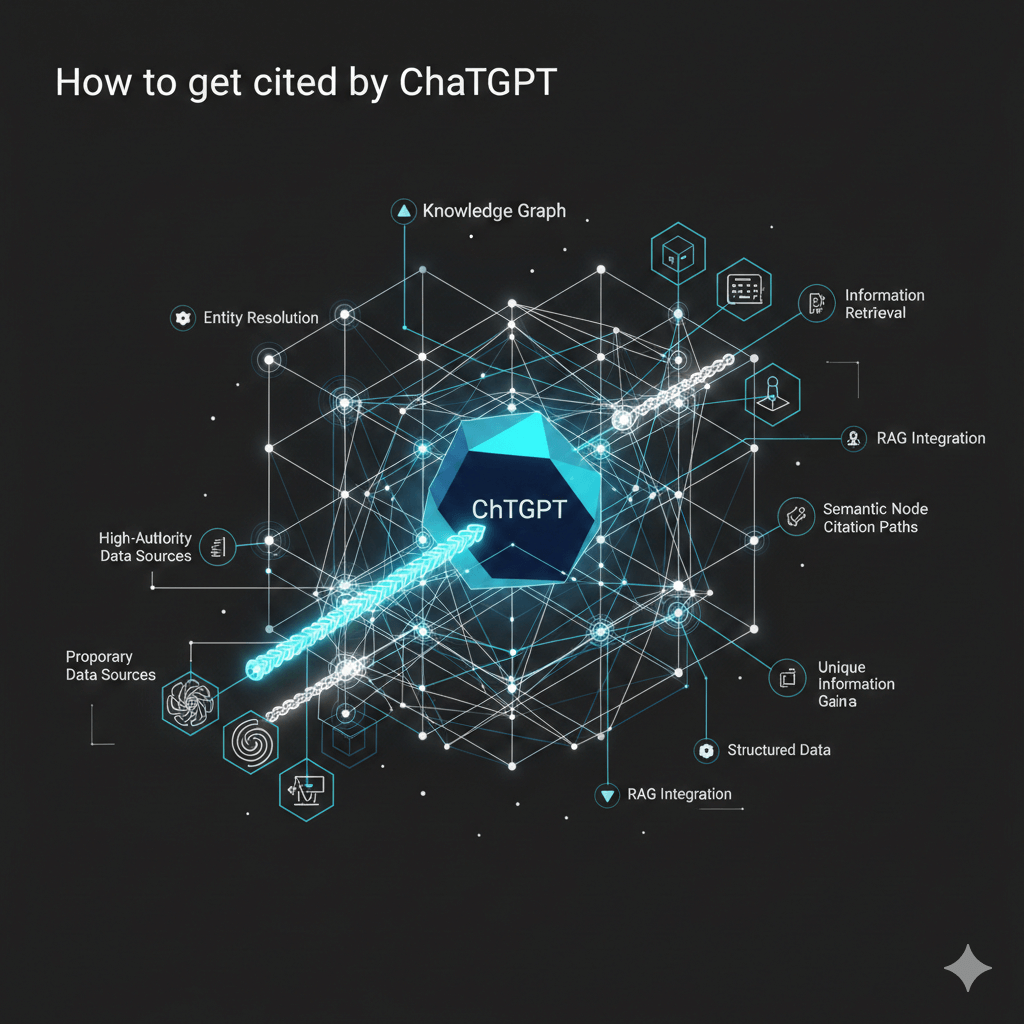
To get cited by ChatGPT, brands must optimize for Generative Engine Optimization (GEO) by prioritizing technical authority, structured entity relationships, and unique data insights. Success requires high citation density, expert-verified content, and technical accessibility that allows LLMs to parse and attribute your specific insights as the primary source of truth.
If your brand is missing from AI-generated responses, you are effectively invisible to the modern B2B buyer. The loss of market share to "hallucinated" competitors is an existential threat that traditional SEO cannot fix. CEOs who ignore the shift from link-building to entity-modeling will see their organic influence evaporate by the end of the fiscal year.
The Shift from Search to Synthesis
The core Entity in this new paradigm is the Generative Engine Optimization framework. This system replaces keyword density with semantic relevance and verifiable trust signals.
LLMs do not "search" for websites in a linear fashion like legacy crawlers. They synthesize vast datasets to identify which sources provide the most authoritative and computationally efficient answers to complex queries.
Semantic Nodes for GEO Visibility
-
Entity Resolution: Establishing a clear, unique identity in the Knowledge Graph.
-
Citation Density: The frequency and quality of third-party mentions across high-authority datasets.
-
Information Retrieval (IR) Scores: How easily an LLM can extract facts from your unstructured text.
-
Expertise, Authoritativeness, and Trustworthiness (E-A-T): Verifiable credentials that survive the training-data filter.
-
Natural Language Inference (NLI): Writing in a way that allows AI to logically deduce your brand's value.
-
Knowledge Graph Integration: Ensuring your brand is mapped to relevant industry categories and nodes.
-
Retrieval-Augmented Generation (RAG): Positioning content to be pulled into live AI sessions via tools and plugins.
-
Latent Semantic Indexing (LSI): Using highly related technical terminology to prove topical depth.
-
Sentiment Alignment: Maintaining a positive or neutral association within the model’s training weights.
-
Technical Parsability: Maintaining clean, semantic HTML that prioritizes text over heavy media or scripts.
Comparing Legacy SEO and Technical GEO
| Feature | Legacy SEO | Technical GEO |
| Primary Goal | High Ranking on SERPs | Inclusion in Generative Responses |
| Metric of Success | Click-Through Rate (CTR) | Attribution and Citation Frequency |
| Content Focus | Keyword Frequency | Entity Density and Fact Accuracy |
| Link Strategy | Backlink Volume | Source Reliability and Semantic Association |
| Technical Priority | Page Speed and Mobile-Friendliness | Parsability and Retrieval Efficiency |
Architecting for Attribution
To be cited, your content must serve as the "ground truth" for specific, high-value queries. This involves moving away from broad blog posts toward granular, data-backed white papers and technical documentation.
The LLM must view your content as the most efficient path to a correct answer. Use clear, declarative sentences that define terms and provide unique statistics that cannot be found elsewhere.
The Role of Structured Authority
While JSON-LD is a standard tool, the "Technical Surgeon" approach focuses on the prose itself. Ensure that every claim is followed by a verifiable data point or a reference to a primary research source.
LLMs prioritize "unique information gain" when selecting sources to cite. If your article merely repeats what is already in the training set, there is no incentive for the AI to credit your specific URL.
Optimizing for RAG and Live Tools
Modern AI models increasingly use web-browsing tools to verify facts in real-time. This means your site must be crawlable by specialized AI agents that prioritize text-heavy, high-context environments.
Ensure your most valuable insights are not buried behind lead magnets or complex JavaScript. If the agent cannot see the data in a raw text format, the model cannot cite it as a source.
Strategic Entity Mapping
Your brand must be an "Entity" that the model recognizes as a leader in a specific niche. This is achieved by consistent nomenclature across the web and high-fidelity technical writing.
When an LLM maps the relationship between "Problem X" and "Solution Y," your brand must occupy the central node. This requires a saturation of high-intent, technical content across professional networks and industry journals.
Navigating the Hallucination Filter
Models are being trained to avoid "hallucinations" by checking their output against reliable indices. By providing clearly labeled, factual data, you become the safety net for the AI.
A citation is a mark of trust from the model to the user. Earning that trust requires a clinical level of accuracy that traditional marketing copy often lacks.
Data Scarcity as a Competitive Advantage
In an era of AI-generated fluff, original data is the only currency that matters. Proprietary surveys, internal benchmarks, and case studies are the primary targets for AI citations.
The more "scarce" and "accurate" your information is, the higher the probability that ChatGPT will fetch your site as the definitive source. Focus on creating "data islands" that the AI cannot ignore.
Surgical Diagnostic: The AI Visibility Scorecard
Most organizations are flying blind in the new generative economy. Beyond Search Media offers a specialized audit to determine your current "Entity Strength" and citation potential.
Our AI Visibility Scorecard provides a raw look at how LLMs perceive your brand authority compared to your competitors. We identify the technical gaps preventing your insights from being synthesized and cited by top-tier models.
Would you like to see how your current digital footprint measures up against the latest LLM training parameters? Contact Beyond Search Media for your custom diagnostic and secure your place in the next generation of search.