
Beyond Search Media
Entity-First Architecture: Building Knowledge Graphs for 2026 AI Visibility
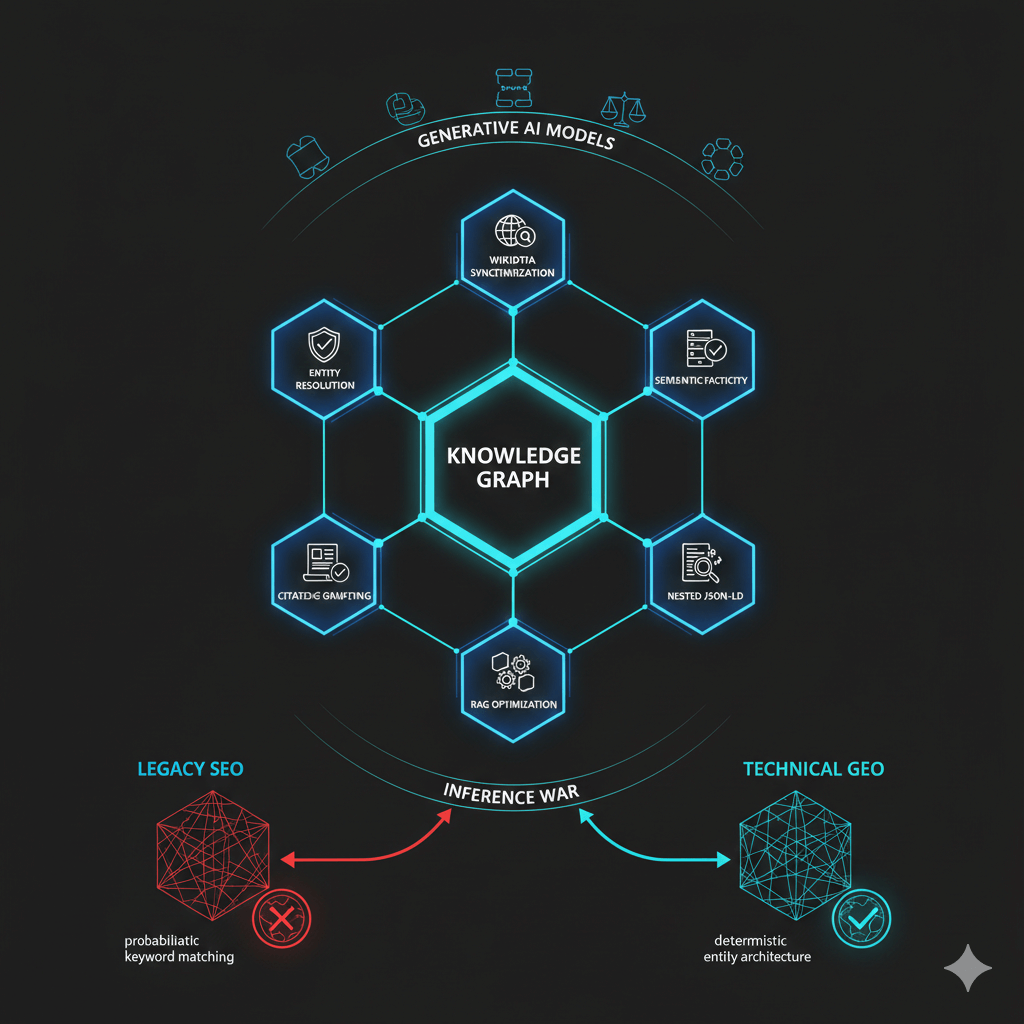
The Death of the Keyword: The Rise of the Entity
In 2026, generative engines no longer "rank" websites in a linear list; they synthesize answers based on verified relationships between entities. If your brand lacks the structural guts for machine verification, your technical flagship is invisible to the crawlers that power ChatGPT, Gemini, and Claude.
Legacy SEO relies on the "strings" of keywords, which are increasingly ignored by high-dimensional vector models. Modern visibility requires "things"—the discrete, unique nodes within a global Knowledge Graph that prove your brand's existence and expertise.
Legacy SEO vs. Technical GEO
| Metric | Legacy SEO (Probabilistic) | Technical GEO (Deterministic) |
|---|---|---|
| Primary Objective | SERP Rankings (Traffic) | Entity Citation (Inference) |
| Core Asset | Keywords and Backlinks | Knowledge Graph Nodes (QIDs) |
| Architecture | Unstructured HTML / Meta Tags | Nested JSON-LD & llms.txt |
| Primary Agent | Human Searchers | Generative AI Models |
| Success Metric | Click-Through Rate (CTR) | RAG Retrieval Fidelity |
The 10 Semantic Nodes of AI Visibility
To dominate the generative landscape, a Technical Surgeon must architect specific entity nodes with clinical precision. These nodes serve as the machine-readable foundation for all automated brand citations.
1. Entity Resolution
Establishing a unique, non-ambiguous identifier for your brand within the global Knowledge Graph. This prevents LLMs from confusing your firm with unrelated entities during high-speed retrieval.
2. Wikidata Synchronization
Connecting your brand to persistent identifiers like QIDs (Wikidata IDs). This provides decentralized machine verification that remains consistent across all training sets and frontier models.
3. Semantic Facticity
Maximizing the ratio of verifiable data points per page. High fact-density establishes a "Truth Vector" that AI crawlers prioritize over marketing fluff during the RAG process.
4. Knowledge Vaulting
Ensuring core brand facts are represented in base training data and high-authority repositories. This makes your brand an "immutable fact" within the model's latent space.
5. Citation Graphing
Building a network of high-authority technical mentions that triangulate your expertise. These mentions serve as cross-referenced proof for AI verification layers.
6. Nested JSON-LD
Hard-coding the relationships between executives, products, and outcomes using hierarchical schema. This machine-readable logic is ingested immediately without the need for probabilistic guessing.
7. RAG Optimization
Structuring content into high-context, chunkable segments for easy vectorization. This ensures that when a specific query is made, the engine retrieves your specific data with high fidelity.
8. LLM Directives (llms.txt)
Implementing an llms.txt file at the root level of your domain. This provides an explicit roadmap for AI agents, allowing them to bypass the noise of legacy web crawlers.
9. N-Gram Alignment
Synchronizing professional vocabulary with high-expertise vectors used by technical models. This signals clinical competence to the model's latent processing layers during ingestion.
10. Consensus Engineering
Ensuring all third-party data sources align perfectly with your internal source of truth. This eliminates entity ambiguity and prevents the AI hallucinations that lead to brand exclusion.
How Answer Engines Process Your Competence
Answer engines function through high-dimensional vectorization, where your brand is represented as a series of mathematical coordinates. If your content is vague or unstructured, your vector remains ambiguous and unsearchable by the generative machine.
This ambiguity causes AI models to either ignore your brand entirely or hallucinate a competitor into your space. A Technical Surgeon sharpens these coordinates through fact-dense architecture, ensuring your entity is the only logical choice for selection.
By 2026, the code is the primary interface, and the website's visual design is secondary. If your "guts" are not deterministic, your brand remains a ghost in the machine.
Surgical Diagnostic: Resolve Your AI Invisibility
If your brand is currently omitted from the citation list of ChatGPT or Perplexity, you are suffering from a terminal Entity Infection. Your technical architecture is failing to provide a clear signal to the crawlers that now control your market share.
The Beyond Search Media AI Visibility Scorecard is the only clinical audit designed to map your brand's specific citation gaps. We identify the "Red Errors" in your schema and Knowledge Graph presence that cause engines to bypass your authority.
Failing to diagnose these gaps is a strategic choice to remain invisible to the global economy. Secure your diagnostic report now to begin the surgical re-engineering of your digital authority.